
Balancing Pleasure, Engagement, and Purpose… Life After the Corner Office
May, 2026
One of the more useful frameworks for understanding retirement comes from Riley Moynes, whose TED Talk on the four phases of retirement resonates with many senior leaders stepping away from full-time roles. Here is a link to that thirteen minute TED talk.
Moynes’ insight is simple but powerful: retirement is not a single event—it is a progression.
Phase 1: The Vacation Phase
For most executives, retirement begins with relief. The calendar clears. The pressure lifts. There is time—finally—for travel, family, and long-deferred interests. It feels like success.
But as many discover, the satisfaction of this phase is temporary. What initially feels like freedom can begin to feel unstructured, even empty.
Phase 2: The Loss Phase
This is the phase few talk about openly—yet it is where many executives struggle most. The losses are real: structure, identity, influence, relevance, power and daily connection. For leaders accustomed to responsibility and impact, this can be disorienting.
Ignoring this phase doesn’t shorten it. Understanding it does.
Phase 3: The Trial-and-Error Phase
Gradually, most leaders begin to re-engage. They test possibilities—board work, mentoring, consulting, volunteering, new ventures. Some efforts fall flat. Others spark energy.
This phase rewards curiosity and humility. It is less about getting it right and more about staying in motion.
Phase 4: The Reinvention Phase
Over time, a clearer direction emerges. Many executives find meaningful ways to apply their experience—often with greater flexibility and autonomy than before. This is where purpose takes hold, and where retirement begins to feel less like an ending and more like a transition.
Moynes is right: those who reach this phase tend to report the highest levels of fulfillment.
Where the Model Falls Short
For many high-achieving leaders, Moynes’ framework leads to a subtle but important assumption: that purpose is the ultimate goal of retirement.
Purpose is powerful—but it is not sufficient on its own.
Executives who focus exclusively on purpose often recreate a version of their former work life—structured, demanding, and externally driven—while missing two equally important dimensions of a satisfying second half: pleasure and engagement.
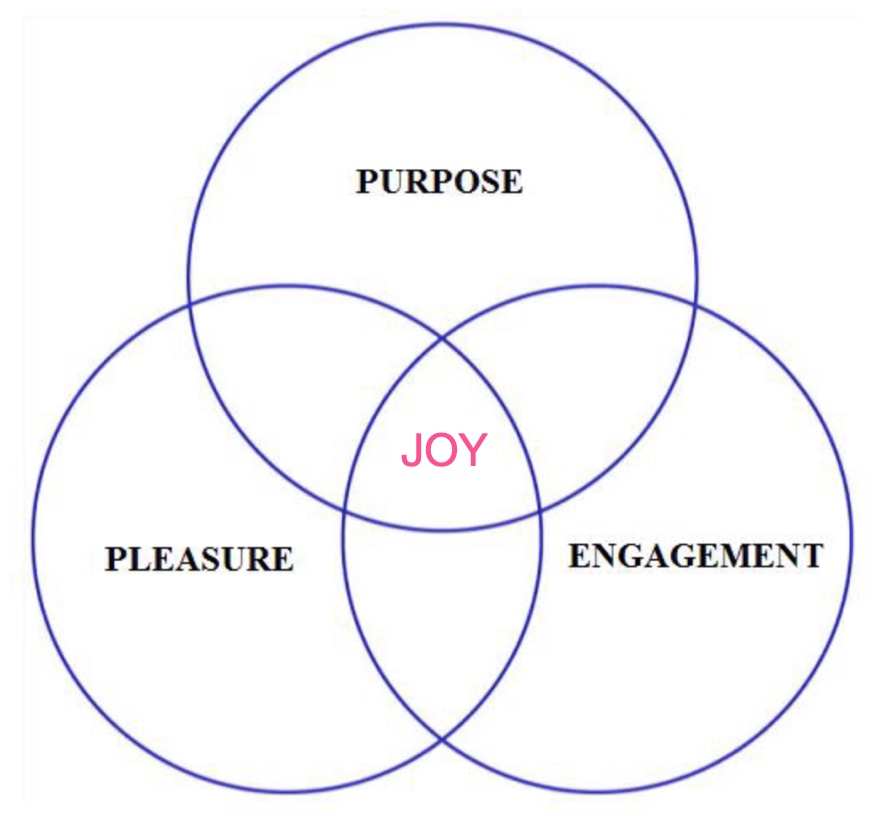
A more complete model comes from the work of Richard Bolles and John Nelson in What Color Is Your Parachute? For Retirement. They describe three essential elements of retirement satisfaction: pleasure, engagement, and purpose.
Rather than viewing these as a hierarchy, a better way to think about them—especially for executives—is as an integrated system. When all three are present, the outcome is not just satisfaction, but sustained joy.
Pleasure: More Strategic Than It Sounds
Executives often underestimate the role of pleasure.
After decades of performance, optimization, and responsibility, simple enjoyment can feel unproductive—or even indulgent. That is a mistake.
Pleasure is not trivial. It is restorative.
It includes the activities that bring ease and enjoyment: travel, time with family, hobbies, physical activity, and social connection. In the early stages of retirement, pleasure provides necessary decompression.
But it has limits. Its effects are short-lived and must be renewed. Left on its own, pleasure rarely sustains a sense of fulfillment.
The key is to approach it with the same discipline you applied in your career: experiment intelligently. Avoid high-cost, irreversible decisions early on. Test options. Revisit past interests. Try new ones.
Pleasure answers a simple but often neglected question: What do I actually enjoy?
Engagement: The Executive’s Sweet Spot
If pleasure restores, engagement energizes.
The concept of engagement is best captured by Mihaly Csikszentmihalyi in his work on flow. Flow occurs when your capabilities are well matched to a meaningful challenge. Time disappears. Focus sharpens. The work itself becomes the reward.
For many executives, this is the missing piece in early retirement.
Engagement is not passive. It requires effort, learning, and risk. It lives in Moynes’ third phase—the trial-and-error stage—and is discovered through action.
The objective is not to stay busy, but to find the right level of challenge:
- Too little, and you experience boredom
- Too much, and you create stress
- The right balance produces energy and momentum
Engagement often emerges from unexpected places. As psychologist John Krumbolz observed, fulfilling paths are often the result of “planned happenstance”—remaining open and acting on opportunities as they arise.
Engagement answers the question: Where can I still grow—and contribute at a high level?
Purpose: Still Essential—But Not Exclusive
Purpose remains a cornerstone of a meaningful retirement. It is where your experience, values, and interests align in service of something larger than yourself.
For many executives, this takes the form of mentoring, governance, philanthropy, or community leadership.
Thought leaders like Richard Leider emphasize that purpose is not conceptual—it is behavioral. It requires direct involvement. Writing a check is not the same as showing up.
Done well, purpose provides continuity. It allows you to carry forward the best of your leadership into a new context.
But purpose alone can become over-structured. It can begin to resemble the very career you left behind.
Purpose answers the question: What matters enough for me to invest my time and energy now?
The Executive Challenge: Integration
The real opportunity in retirement is not choosing between pleasure, engagement, and purpose.
It is integrating them.
- Pleasure ensures your life is enjoyable and sustainable
- Engagement ensures you remain challenged and growing
- Purpose ensures your efforts are meaningful and connected
When one dominates, something is lost:
- Too much pleasure leads to drift
- Too much engagement without purpose can feel empty
- Too much purpose without balance can create burnout
But when all three intersect, the result is something more enduring: joy.
Designing Your Next Portfolio
For executives, this is not an abstract exercise. It is a design challenge.
A well-constructed “portfolio life” in retirement should include:
- Deliberate time for renewal (pleasure)
- Challenging, skill-aligned activities (engagement)
- Commitments that reflect your values (purpose)
Importantly, these do not need to be separate. The most satisfying roles often combine all three—for example, mentoring in an area you care about, or engaging in a pursuit that stretches your abilities while contributing to others.
Moynes’ phases still apply. Early retirement may emphasize pleasure. The middle years are rich with experimentation and engagement. Purpose becomes clearer over time.
But the end goal is not to “arrive” at purpose.
It is to continuously calibrate across all three dimensions.
A Better Question
Many executives enter retirement asking, “What is my purpose now?”
A more effective question is:
“How do I build a life that balances pleasure, engagement, and purpose in a way that creates sustained joy?”
That shift—from a single objective to a dynamic system—may be the most important transition of all.
Because life after the corner office is not about replacing what you had.
It is about designing something better.
